Philippine stocks are trying to bounce back, but domestic consumption and investment are still soft, raising questions about the durability of the recovery. With slower household spending, weaker corporate earnings, and cautious government investment, the market faces headwinds even as valuations look attractive. This blog explores what these trends mean for investors, how global risks and rate policies play a role, and why defensive picks like water utilities may offer a safer path for steady returns. If you’re debating whether the PSEi is ready to turn a corner or if caution is still the better move, this post lays out the context you need to understand what’s really driving the market.
If you’ve been following the Philippine stock market over the past month, you’ve probably felt the rollercoaster. The PSEi fell sharply, at one point down nearly 6%, before bouncing back toward the 6,000 level. The comeback is nice to look at, but if we’re being honest, the foundation underneath still isn’t solid.
We’re in one of those classic market phases where prices are moving more than the underlying story. And that leaves many investors wondering: Is this recovery real? Or is it one of those temporary bounces that eventually fades?
Let’s try to untangle things in plain language.
The economy grew 4% in the most recent quarter. That’s growth, yes, but slower than economists expected. Several things contributed to this:
-
government spending pulled back, partly due to corruption probes and tighter oversight
-
household consumption, which drives about 70% of GDP, rose only 4.1%, its slowest pace since early 2021
-
public construction plunged over 26%, which dragged overall investment lower
Even though inflation averaged just 1.7% and unemployment stayed low at 3.8%, consumers didn’t spend like before, likely influenced by weather disruptions and the school-year shift.
Corporate earnings reflected the same cooling. Roughly half of the companies tracked by financial analyts missed expectations. Telcos struggled with slow revenue and rising costs. Consumer companies felt weaker demand. Power firms were hit by lower electricity prices due to excess supply. And gaming operators faced softer demand plus tighter rules.
The one bit of domestic sunshine is the rising likelihood of a rate cut. With slower growth and manageable inflation, the BSP may lower policy rates by 25 basis points—something that usually helps unlock borrowing, investment, and economic activity, although with a delay.
So yes, the engine is still running. Just at a more modest pace.
Why Global Risks Are Making Things More Complicated?
Even if the Philippines were in perfect shape, the global backdrop isn’t doing us any favors.
The U.S. economy, still the world’s main financial heartbeat—has been showing signs of stress. Loan delinquencies in auto and credit-card debt have climbed to around 5.0% and 12.4%, similar to levels last seen during the Global Financial Crisis. Corporate layoffs have surged, with October alone registering over 153,000 job cuts. Parts of the private credit market are wobbling as well, highlighted by high-profile bankruptcies among non-bank lenders.
Add to that the growing concern that an AI bubble may be forming. Tech giants are pouring staggering amounts of money into AI infrastructure, not always because customers need it today but because nobody wants to risk “falling behind.” Yet real-world adoption hasn’t caught up. A recent MIT study found 95% of companies saw no measurable returns from their generative AI initiatives. Meanwhile, major players like OpenAI remain deeply unprofitable, posting estimated losses of US$7.8 billion in the first half of 2025.
Market valuations reflect this imbalance. The S&P 500 trades at 21 times earnings, well above its 10-year average, and the “Magnificent 7” now account for nearly 40% of the index’s total value. When any single group dominates a market this heavily, the risk of a sharp correction rises.
If the U.S. enters a recession or the AI frenzy cools, the downturn will not stay contained. Emerging markets, including the Philippines, are typically collateral damage.
What Investors Should Actually Do Right Now?
So where does that leave you? The answer depends on what type of investor you are.
If you’re trading for short-term gains, this is a tricky environment. Weak earnings, slower growth, and potential global risks make sustained rallies unlikely. If you’ve enjoyed gains from the recent rebound, taking some profits or reducing your exposure is a reasonable, risk-aware move.
But if you’re a long-term investor, the story is very different. The Philippines is cheap on a valuation basis. The PSEi trades at 8 times forward earnings, a level close to financial-crisis lows. Several blue chips are priced below their 10-year ranges despite posting better profits today. Many yield more than government bonds, which is rare and appealing for investors who want stability or passive income.
Staying invested makes sense in this context. Recoveries often come suddenly, and investors who wait for perfect clarity usually miss the early (and often largest) upside. But long-term investing still requires discipline. Avoid leverage, invest only money you truly won’t need soon, and keep some cash available. Markets could get more volatile before improving, especially if global contagion picks up.
Cash today is optionality tomorrow.
Why Some Investors Are Swapping SM for Maynilad Right Now
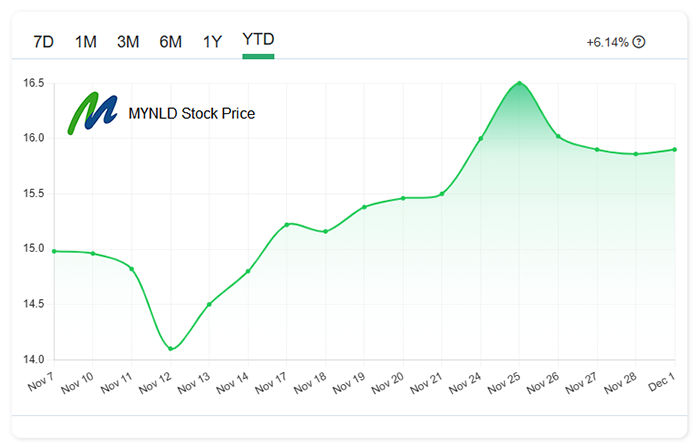
Maynilad (MYNLD) YTD Stock Price Chart
Lately, you may have noticed a subtle shift in investor behavior. With the economy showing signs of slowing, some people are moving their money away from cyclical or consumer-heavy stocks and into more defensive plays. A clear example of this is the growing comparison between retail-focused conglomerates like SM Investments and water utilities like Maynilad (MYNLD).
Take SM, for instance. Retail earnings have taken a hit, with profits dropping around 27% year-on-year. Sales barely grew, and heavy discounting squeezed already thin margins. On top of that, external factors like weather disruptions further dampened consumer spending. With these conditions likely to persist in a soft economy, SM may struggle to bounce back quickly in the near term.
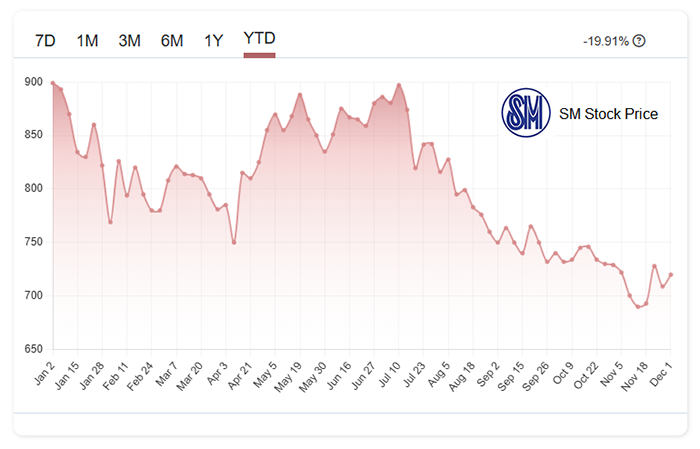
SM Investments (SM) YTD Stock Price Chart
Meanwhile, water utilities tell a very different story. People always need water, no matter if the economy is booming or slowing down. That makes demand much more stable, even in turbulent times. Some providers, like Maynilad, also operate under long-term government concessions which run all the way until 2047 with regulated returns of roughly 12% on approved investments. This framework gives investors a sense of predictable, resilient earnings that retail simply can’t match in a downturn.
Valuation adds another layer of appeal. At around ₱15.86 as of this writing, Maynilad offers a projected 2026 dividend yield of about 6.8%, higher than the 10-year Philippine government bond. Analysts also see over 20% upside potential to fair value estimates, giving defensive investors both income and growth opportunities, a combination that’s hard to find in today’s volatile market.
Put simply, MYNLD offers stability, predictable income, and reasonable upside, making it an attractive alternative for those who want to protect their portfolio without missing out on long-term growth. It’s the kind of stock that can help you sleep easier at night while still keeping you positioned for the recovery ahead.
Final Thoughts
At the end of the day, Philippine stocks offer a mix of opportunities and caution. While challenges like slower consumption, global uncertainty, and selective corporate performance remain, there are still pockets where patience and careful choices can pay off. Investors who understand their own risk tolerance and focus on quality whether that means steady, defensive plays like water utilities or selectively undervalued blue chips—are positioned to navigate this environment more confidently. The market won’t always move in straight lines, but with clarity and discipline, it’s possible to stay invested without losing sight of your long-term goals. In other words, this is a time for thoughtful action rather than reaction. Watch, learn, and choose wisely.