The way prices changed in 2026 was felt in many everyday decisions, from grocery shopping to monthly bills. One way to understand this shift is to look at the purchasing power of the peso. By October 2026, one peso could buy only what 72 centavos could buy in 2018, according to the Philippine Statistics Authority (PSA). In other words, the same amount of money covered less than it did several years ago.
A range of local and global developments influenced prices and economic activity throughout the year. Fuel prices rose, the peso weakened against the US dollar, and rice became more expensive, while economic growth slowed. These changes affected households, businesses, and investors in different ways. There were also areas of strength: remittances continued to grow, and exports reached a record high.
In this blog post, we'll look at the key developments behind the Philippine economy's performance in 2026 and what they mean for everyday spending, employment, businesses, and investments. We'll also consider what may lie ahead in 2027 and share some practical ways to manage your finances and make informed decisions in the coming year. All figures and developments are current as of mid-November 2026.
-
2.1%
GDP growth, July to September
-
7.8%
Inflation, October
-
₱64.17
Peso record low per US$, October 27
-
5.5%
BSP policy rate since October 22
-
5.4%
Unemployment, September
1. How the Philippine economy performed in 2026
First, a quick refresher. Gross domestic product (GDP) is the total value of everything the country produces. Its growth rate tells us how much bigger the economy got compared with a year earlier.
In 2026, that growth kept shrinking. The economy grew 2.8% in January to March, 2.4% in April to June, and just 2.1% in July to September. That's five straight quarters of slower growth, the longest streak since 2011. Outside the pandemic years, it's the slowest pace since 2009.
The government lowered its expectations twice. It had aimed for 6% to 7% growth in 2026, cut that to 5% to 6% in January, then to 3.5% to 4.5% in July. With growth averaging just 2.5% in the first nine months, even the lowered target looked out of reach by November.
Private forecasters are even more cautious. In November, Nomura cut its 2026 growth forecast to 3% and BMI cut its forecast to 2.6%, both below the government's target. UOB expects 2.5%.
Our neighbors did much better. In April to June, Vietnam grew 8.39%, Singapore 5.7% and Indonesia 5.29%.
What it meant for jobs
Slow growth shows up in jobs. Unemployment hit 6% in July, the highest since mid-2022, as fresh graduates flooded the job market. By September it was 5.4%, or 2.86 million jobless Filipinos, up from 1.96 million a year earlier.
The labor force grew by 1.63 million people in a year, but only about 721,000 more found work. Another 5.56 million Filipinos had jobs but needed more hours or more work.
OFW remittances as a source of support
Money from overseas Filipinos kept coming. Cash remittances reached $23.42 billion from January to August, up 2.2% from a year earlier, according to the BSP. August alone was up 1.9%. Growth is slow, but it's a steady lifeline for millions of households.
2. The events that shaped the Philippine economy in 2026
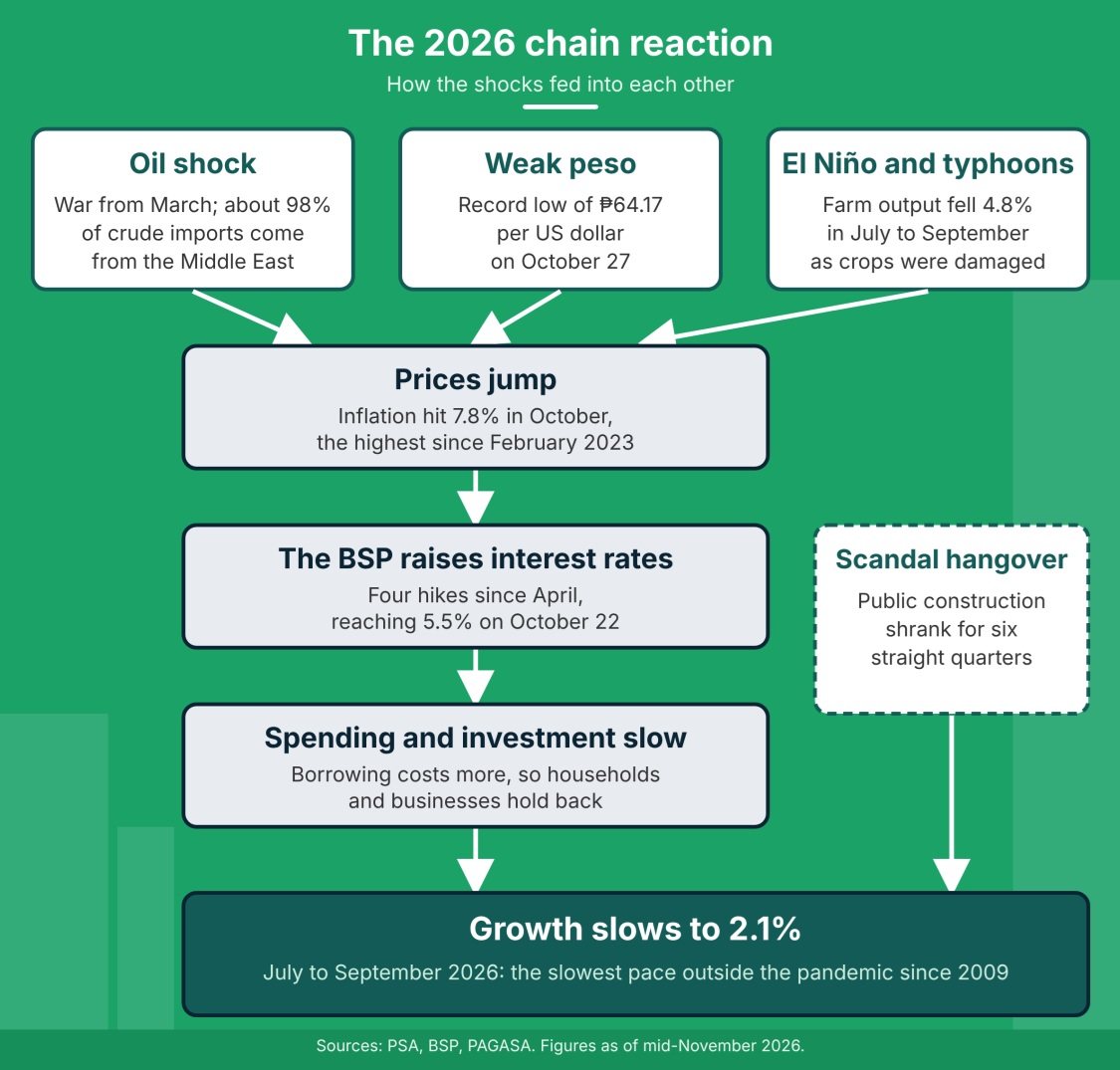
No single thing slowed the economy. Several shocks hit at once, and each one made the others worse.
The continuing effects of the flood-control scandal
The flood-control corruption scandal that broke in 2025 didn't stay in 2025. As investigations dragged on, government construction slowed sharply. By July to September, public construction had shrunk for six straight quarters: down 33.4% in April to June and 15.1% in July to September.
When public projects stall, the effect spreads. Contractors and their workers lose income, cement and steel suppliers sell less, and even the carinderias near construction sites feel it.
How rising oil prices affected the economy
In March, the war involving the US, Israel and Iran sent global oil prices soaring. That hit the Philippines especially hard, because about 98% of our crude oil imports come from the Middle East.
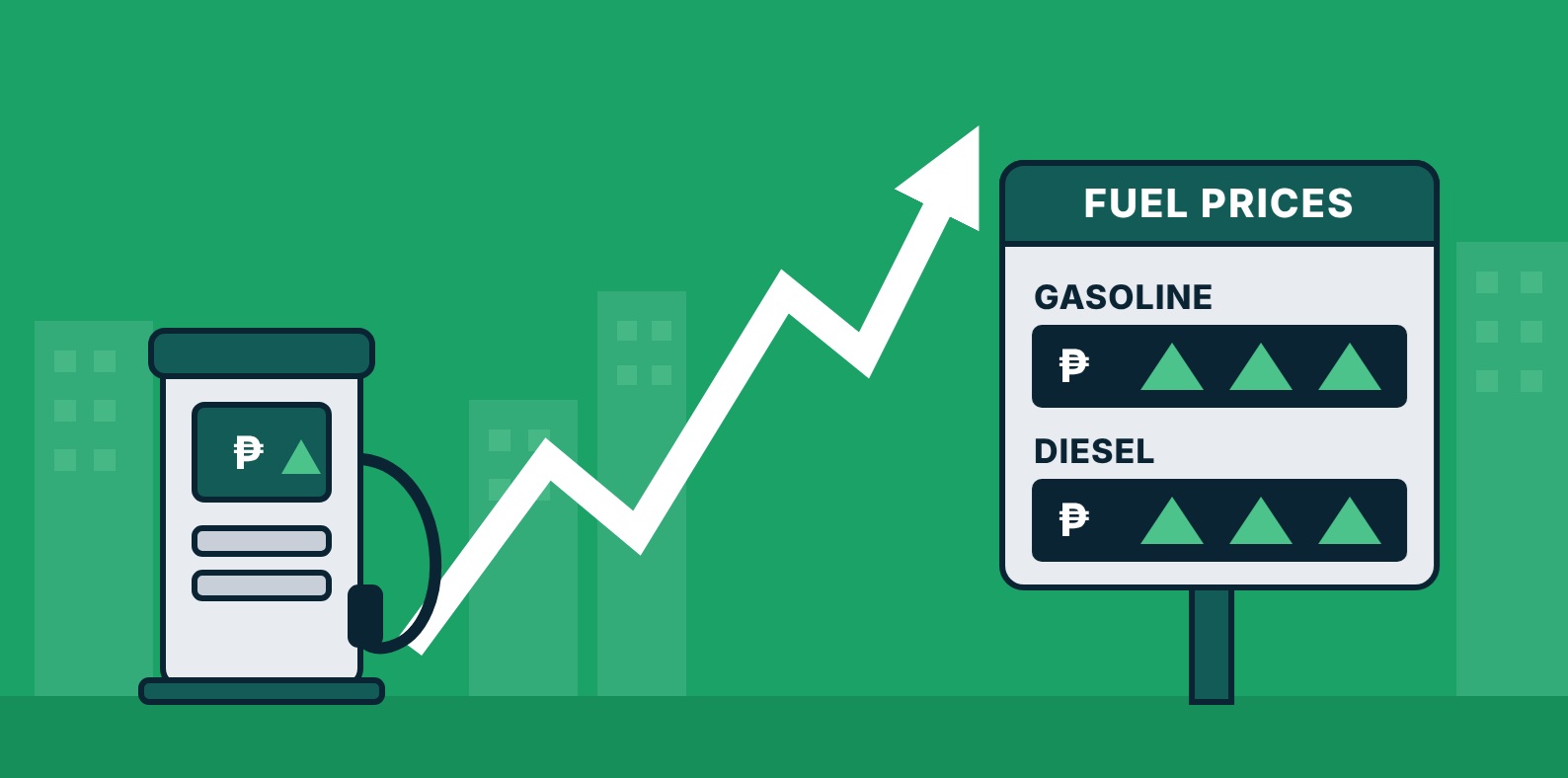
In late February, before the war escalated, gasoline cost around ₱54 a liter and diesel around ₱60. By mid-March, the Department of Energy warned diesel could reach as high as ₱114.90 a liter in parts of Metro Manila. Prices rose and fell for the rest of the year with every flare-up and every round of peace talks.
Fuel touches everything: jeepney and bus fares, delivery costs, electricity, and the price of food trucked from farms to markets.
The weak peso
The peso started 2026 at about ₱58.79 to the US dollar. On October 27, it closed at an all-time low of ₱64.17, its 38th record low of the year. It closed at ₱63.72 on November 13.
Why? When oil costs more, the country needs more dollars to pay for it. A strong US dollar and nervous investors added to the pressure.
Why being a net importer hurts
The Philippines buys far more from the world than it sells. From January to September, we imported $121.11 billion worth of goods and exported $73.95 billion. We pay for imports in dollars, so a weaker peso makes imported fuel, rice, machinery and medicine more expensive in pesos.
There is good news here, too. Exports hit a record high, and electronics made up 70% of September's exports.
El Niño and typhoons
The weather piled on. Typhoons and heavy monsoon rains damaged crops in the middle of the year, and El Niño had been building since May. Farm output shrank 4.8% in July to September, and palay and corn harvests fell by more than 17%.
On November 4, PAGASA called the El Niño "very strong." It said the event may peak by the end of 2026 and last into the first half of 2027. Farm damage from El Niño had reached ₱8.57 billion by October. To keep rice on the shelves, the country imported a record 2.75 million metric tons in the first half of the year alone.
3. Understanding inflation and its effect on everyday expenses
Inflation measures how quickly prices rise over time. For example, when inflation is at 5%, something that cost ₱100 a year ago would now cost about ₱105. While the change may seem small over a short period, its effect becomes more noticeable over several years as the purchasing power of money gradually declines. You can use our inflation calculator to see how much the value of your money has changed between different years.
In January, inflation was a calm 2.0%. Then the oil shock hit. It jumped to 7.2% in April, eased to about 6% by August, and climbed again to 7.8% in October, the highest since February 2023. For the first ten months, it averaged 5.6%, well above the government's 2% to 4% target.
In peso terms: on average, what cost ₱1,000 in October 2025 cost about ₱1,078 in October 2026.
What rose the most
In October, compared with a year earlier:
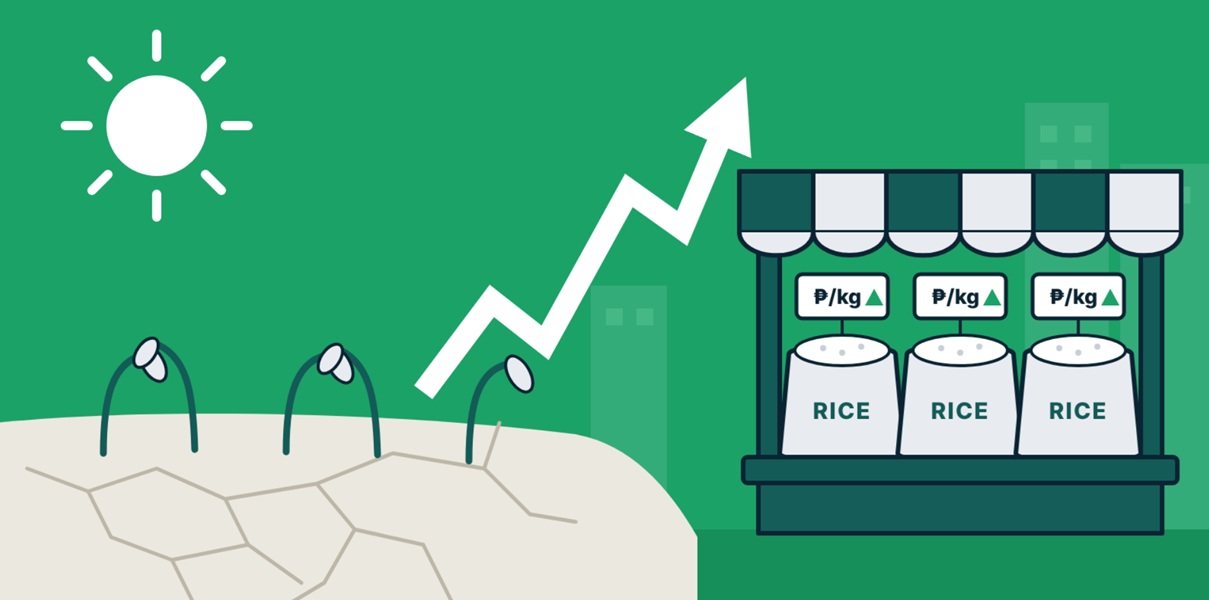
- Rice: up 20.7%. Regular milled rice averaged ₱49.87 a kilo, up from ₱40.16.
- Transport: up 20.1%
- Housing, water, electricity and fuel: up 9.3%
- Food overall: up 6.4%
The poorest families feel it most. For the bottom 30% of households, inflation hit 9.5% in October, because more of their budget goes to food and fuel.
How wage increases compare with rising prices
In mid-2026, Metro Manila's wage board approved an ₱85 daily raise, from ₱695 to ₱780, the biggest it has ever granted. But a Pasig court froze it after companies challenged it, and labor groups took the fight to the Supreme Court.
To give workers some relief while the case is pending, the wage board issued a separate ₱60 raise. It took effect on September 26, lifting the daily minimum wage for non-farm workers in Metro Manila to ₱755. That's an increase of about 8.6%: a little above October's 7.8% inflation, but below the 9.5% rate the poorest households faced, and far behind the 20.7% jump in rice prices.
For context, the government's official poverty line for 2025 was about ₱14,634 a month for a family of five, or roughly ₱488 a day. That covers only the bare minimum of food and basic needs, and it reflects prices from before the 2026 price spike.
Will it ease?
Not right away. The BSP expects inflation to average 6.1% in 2026 and 6.0% in 2027. RCBC chief economist Michael Ricafort sees inflation staying at 7% to 8% until around February 2027, then easing to 5% to 6%.
4. How interest rates affect your loans and savings
The Bangko Sentral ng Pilipinas (BSP) sets a key interest rate called the policy rate. Banks use it as a guide for what they charge on loans and pay on deposits. When the BSP raises it, borrowing gets more expensive, people spend less, and price increases slow down.
In February, the BSP cut its rate to 4.25% to help the slowing economy. Then the oil shock changed everything. It raised rates in April, June and August, then surprised the market on October 22 with a bigger half-point hike to 5.5%. All 27 economists in a Reuters poll had expected a smaller move.
Why raise rates when the economy is already slow? The BSP wants to stop high prices from spreading into wages, rents and everything else, which would be harder to undo later. Higher rates also make the peso more attractive to hold. The BSP's next meeting was set for December 17, and some economists expect another hike.
If you borrow
Credit card debt grew fast. Credit card loans reached ₱1.27 trillion in May, up 26.3% from a year earlier. Credit rater Fitch has warned that fast growth in unsecured consumer loans could become a problem as incomes get squeezed.
If you carry a balance, paying it down is one of the best "investments" you can make. If you're about to take a car, housing or business loan, ask whether the rate is fixed or can change, and how much your payment would rise if rates go up again.
If you save
Higher rates do have an upside. From late September to early October, the government sold Retail Treasury Bonds (RTB 32) paying 6.875% a year. They pay interest every three months, mature in 2.5 years, and start at just ₱5,000. Investors bid for more than six times what the government first planned to sell.
Two things to keep in mind. The interest is taxed 20%, so 6.875% becomes about 5.5% in your pocket. And with October inflation at 7.8%, even that doesn't fully keep up with prices. Still, it beats money sitting in an account that pays almost nothing.
5. Business and investment mood
The BSP surveys hundreds of companies every month and thousands of households every quarter. Their answers show how confident people feel. A negative score means pessimists outnumber optimists.
Business confidence fell to −35.8 in April as the oil shock hit. It recovered to zero in June, dropped to −20.3 in July when tensions flared again, and improved to −10.9 in August. Looking three months ahead, businesses turned upbeat at +24.6, expecting the harvest season and holiday shopping to lift demand.
Household confidence fell to −42.0 in April to June, the lowest since the pandemic. It improved to −29.8 in July to September. For October to December, households expect things to be close to neutral, at −0.8.
Foreign investors are cautious
Foreign direct investment (FDI), the money foreign companies put into factories, offices and businesses here, reached only about $4.8 billion from January to August, down from about $5.9 billion in the same period of 2025.
What the credit raters say
Credit ratings work like a country's credit score. They affect how much the government and big companies pay to borrow. On April 8, S&P lowered its outlook on the Philippines from positive to stable. On April 20, Fitch cut its outlook to negative, which means a downgrade is possible within one to two years. On August 24, Moody's kept its Baa2 rating and stable outlook. The country remained investment grade with all three.
6. How AI and cybersecurity are shaping the future
Two forces will shape Filipino jobs and money long after the oil shock fades: artificial intelligence and cybercrime.
How AI could change jobs and business opportunities
AI is already helping in one place: exports. Global demand for AI-related chips and products pushed Philippine electronics exports up 19.4% in July to September.
The bigger question is jobs. A February 2026 International Labour Organization (ILO) brief estimated that 27.7% of Filipino jobs, about 12.7 million, are exposed to generative AI. That's the highest share among ASEAN countries with comparable data. Only 3.6% of jobs fall in the highest-risk group, though. The World Bank's World Development Report 2026 also counts the Philippines among the most exposed economies, because so many jobs are in business process outsourcing (BPO).
"Exposed" doesn't mean "lost." Many of these jobs will change rather than disappear, and estimates vary widely. Research firm Capital Economics cites industry estimates of about 1 million BPO jobs vulnerable to automation by 2030. Economy Secretary Arsenio Balisacan says the threat may be overstated. The BPO industry group IBPAP still expects the sector to reach $42.3 billion in revenue and 1.96 million workers by the end of 2026.
The government is training 10,000 BPO workers in AI tools in 2026, plus 34,000 more workers through TESDA partner schools.
The growing risks of online scams
Scams have become part of everyday life. In the Global Anti-Scam Alliance's State of Scams in the Philippines 2026 report, 84% of Filipino adults said they had encountered a scam, up from 77% in 2025. Some 44% interacted with one, and 15% lost money.
Official numbers point the same way. The Cybercrime Investigation and Coordinating Center (CICC) received 18,633 complaints from more than 13,000 people in 2025. Consumer fraud led the list with 6,453 cases, about 35% of the total. The PNP recorded 4,509 online scam cases from January to June 2026, down from 5,526 a year earlier, but police counts include only the cases people report.
Your personal data can also leak from places you don't control. On November 10, 2026, the National Privacy Commission confirmed it had received data breach notifications from 10 government agencies, including the BIR, the SEC and the DICT.
Scammers use leaked personal data and AI to fake voices, photos and videos, and the CICC has warned that love scams are getting more convincing with AI. The goal is usually the same: tricking you into sharing a one-time PIN or approving a transfer.
Watch out for these red flags:
- Someone asks for your OTP or MPIN.
- A "bank" or "relative" calls or messages from an unknown number.
- A link asks you to "verify" or "update" your account.
- A deal, job offer or investment that's too good to be true.
- Pressure to act right away.
7. The stock market: the PSEi, the GCash IPO and dividend investing
The Philippine Stock Exchange index (PSEi) tracks 30 of the country's biggest listed companies. On November 13, it closed at 5,593.49, its lowest close of 2026, as the peso weakened. As of late October, foreign investors had sold about $623 million worth of local shares in 2026.
The reasons are the ones you've read above. Higher interest rates, a weak peso and slow growth all squeeze company profits.
The GCash IPO and what its debut tells investors
An initial public offering (IPO) is when a company first sells shares to the public. The PSE had no IPOs at all in the first half of 2026. Then came the big one.
Mynt, the company behind GCash, listed on October 20 under the ticker GCASH. It raised ₱60.9 billion, the biggest IPO in PSE history, beating Monde Nissin's ₱55.89 billion in 2021. During its first week, more than 140,000 people traded about ₱1.1 billion worth of shares through GStocks in the GCash app.
But the details matter. Mynt priced its shares at ₱6.60, 34% below the ₱10 ceiling it had been cleared to charge. The stock closed flat at ₱6.60 on its first day and ended its first week at ₱6.27. That's not unusual: four of the PSE's five largest IPOs closed below their offer price on day one.
The business itself is strong. GCash earned ₱17.25 billion in 2025, up 55%, and had 41.5 million monthly active users in the second quarter of 2026.
The GCash IPO timeline
-
Mynt's board approves the IPO filing.
-
The PSE approves the listing.
-
The offer price is set at ₱6.60 a share.
-
The offer period.
-
GCASH lists on the PSE and closes flat at ₱6.60.
-
The first week ends with a close of ₱6.27.
The lesson: a famous brand doesn't guarantee a quick profit. What matters is the company's earnings, the price you pay, and how long you're willing to hold.
Dividend investing when the market is uncertain
Some PSE-listed companies share a portion of their profits with shareholders through scheduled cash dividends. These payments can provide income while investors wait for stock prices to recover. In an uncertain market, this is one reason analysts often advise taking a defensive approach by looking at well-capitalized banks, companies that earn in dollars, and businesses with a track record of paying steady dividends.
Real estate investment trusts (REITs) are among the options investors consider because they are required to distribute most of their income. In August, several large REITs had dividend yields ranging from about 6% to 8%. At those rates, a ₱100,000 investment would generate roughly ₱6,000 to ₱8,000 in dividends per year, before tax.
However, dividend-paying stocks are not automatically the better option. By the end of October, the 10-year government bond was yielding about 8.1%, while the latest retail bond offered a fixed rate of 6.875%. With government bonds offering returns close to those of some REITs, investors have to weigh whether the potential for share price growth is enough to justify taking on the additional risk of stocks.
| Stock | Div. Yield | Latest Ex-Date | Market Cap |
|---|---|---|---|

AREIT
AREIT, Inc.
|
6.97% | Nov 25, 2026 | ₱114.59 Billion |

RCR
RL Commercial REIT, Inc.
|
7.34% | Nov 24, 2026 | ₱94.29 Billion |

MREIT
MREIT, Inc.
|
9.73% | Nov 9, 2026 | ₱49.87 Billion |

DDMPR
DDMP REIT, Inc.
|
6.97% | Nov 26, 2026 | ₱18.54 Billion |

CREIT
Citicore Energy REIT Corp.
|
7.33% | Dec 10, 2026 | ₱18.13 Billion |

FILRT
Filinvest REIT Corp.
|
8.17% | Nov 23, 2026 | ₱14.19 Billion |

VREIT
VistaREIT, Inc.
|
6.66% | May 22, 2026 | ₱9.83 Billion |
PREIT
Premiere Island Power REIT Corporation
|
6.82% | May 15, 2026 | ₱2.96 Billion |
A simple dividend checklist
- Compare the dividend yield with what a government bond pays.
- Check the company's dividend history. Has it paid steadily for years, even in bad times?
- Be wary of a very high yield. It often means the share price has fallen, sometimes for good reason.
- Remember that companies can cut dividends when cash gets tight.
- Spread your money across several companies and sectors.
- Think in years, not months.
This section is for education only and is not financial advice. Companies named here are examples, not recommendations to buy or sell.
8. What to expect from the Philippine economy in 2027
The Philippine economy may take time to recover from the challenges of 2026, but some developments could help support growth in the coming year. How much they contribute will depend on how conditions unfold, particularly in the first half of 2027.
What could support economic growth in 2027
Exports are one source of optimism. From January to September 2026, the country recorded $73.95 billion in exports, a record high and a 17.2% increase. Remittances from overseas Filipinos also continue to provide support to household spending, with inflows growing slowly but steadily.
Developments in global oil prices could also help. Brent crude fell 7% on November 2 alone as the US and Iran held talks through Qatari mediators. By November 9, prices had reached their lowest level since late August. However, there was no final agreement as of mid-November, so the direction of oil prices remains uncertain.
There are also signs that household sentiment is improving. Consumers expect conditions to be close to neutral by the end of 2026, a considerable improvement from the more pessimistic outlook in the middle of the year. This could help support spending if confidence continues to recover.
For 2027, the government is targeting economic growth of 5% to 6%, while Moody's projects growth of 5.3%. These forecasts point to an expected improvement, although achieving it will depend on how the risks facing the economy develop.
Things to watch
Several developments could influence the pace of recovery and affect household expenses in the months ahead:
- The BSP's December 17 meeting: This is the central bank's last scheduled policy rate decision of 2026. Its decision could affect borrowing costs and the direction of monetary policy heading into 2027.
- Inflation: Forecasts indicate that inflation could remain elevated into early 2027 before easing. This means household budgets may continue to face pressure even if price increases eventually slow.
- El Niño: PAGASA expects the weather event to continue into the first half of 2027. Further effects on agriculture could put rice and other food prices at risk.
- The peso and oil prices: Their direction will partly depend on whether the US-Iran talks lead to a lasting agreement. Changes in oil prices and the exchange rate can affect the cost of imported goods, particularly fuel.
- The ₱85 wage case: Labor groups are still asking the Supreme Court to restore the proposed ₱85 daily wage increase. Some employers, however, argue that the separate ₱60 increase already implemented has made the case moot. The outcome remains worth watching for workers and businesses.
9. Making smarter money decisions in 2027
Here's what all of this means for you, depending on who you are.
For everyday earners and families
- Build or rebuild an emergency fund. Aim for three to six months of expenses, even if you start with ₱500 every payday.
- Pay down credit card balances and other high-interest debt first.
- Budget around food, transport and utilities, the costs rising fastest.
- For savings you won't touch for a few years, compare government retail bonds (from ₱5,000) with what your bank offers.
For OFW families
- The weak peso means each dollar you send converts to more pesos than a year earlier. Save the extra instead of spending it all.
- Use that extra to build your family's emergency fund or pay off debt.
- Be extra careful with remittance and "account verification" scams. Confirm any request through official channels.
For small business owners
- Cash flow comes first. Keep a buffer and collect what's owed to you promptly.
- Review your costs and prices carefully, and explain any price changes to customers.
- Before taking a new loan, check whether the rate can rise.
- Train your staff to spot scams, and back up your records.
For beginner investors
- Don't chase hype. A famous IPO isn't a sure win.
- Invest small amounts regularly instead of trying to time the market.
- Compare any stock's dividend yield with what government bonds pay.
- Think in years, and only invest money you won't need soon.
The bottom line
2026 was a hard year: slower growth, pricier everything, a weaker peso and fewer jobs. But it wasn't a collapse. Exports hit records, remittances kept coming, and savers can earn more on safe government bonds than they could a year ago.
You can't control oil prices or the BSP. You can control your budget, your debt, your savings and your skills. Start there, and you'll be ready for whatever 2027 brings.
Figures are as of mid-November 2026 and come from the PSA, the BSP, the DBCC, other government agencies and the news reports listed below. This article is for general information only and is not financial advice.
Sources
Philippine Statistics Authority (PSA)
- GDP grows 2.1% in the third quarter of 2026
- Inflation report, October 2026
- Inflation report for the bottom 30% of households, October 2026
- Labor Force Survey, July 2026
- Labor Force Survey, September 2026
- Exports and imports, September 2026
- Official poverty statistics, 2025
Bangko Sentral ng Pilipinas (BSP)
- Policy rate history
- Monetary Policy Report, August 2026
- Consumer Expectations Survey, Q2 2026
- Overseas Filipinos' cash remittances
- Foreign direct investment
- Daily peso-dollar reference rates
Development Budget Coordination Committee (DBCC)
Bureau of the Treasury
PAGASA
Department of Energy
National Wages and Productivity Commission
Philippine Stock Exchange
Cybercrime Investigation and Coordinating Center (CICC)
International organizations
Other sources
- Philstar: Nomura and BMI cut Philippine growth forecasts
- Daily Tribune: S&P lowers Philippine outlook to stable
- BusinessWorld: Fitch revises Philippine outlook to negative
- Inquirer: Moody's affirms Philippines' Baa2 rating
- Nation Thailand: Oil falls over 7% on Iran peace hopes
- VERA Files: Global Anti-Scam Alliance survey, 2026
- GMA: CICC complaint figures for 2025
- Daily Tribune: PNP online scam cases, first half of 2026
- NewsBytes.PH: NPC confirms data breach notices from 10 agencies
- Inquirer: PSEi drops to 2026 low as peso weakens